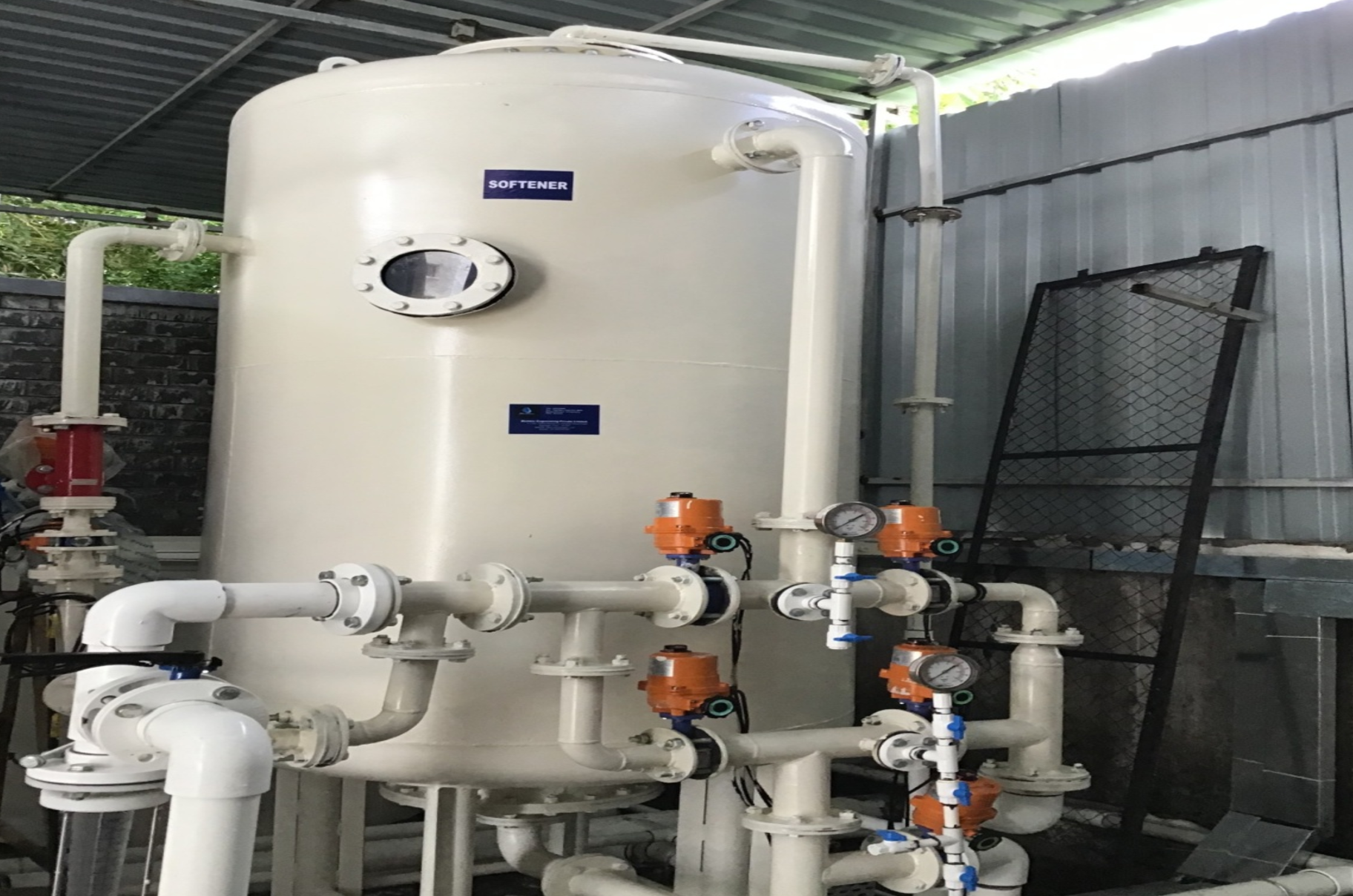
An Industrial Water Softener Plant is a highly efficient system designed to treat hard water by removing minerals such as calcium (Ca²⁺) and magnesium (Mg²⁺) that cause scaling and reduce equipment performance. Hard water is a common issue in many industrial processes, leading to buildup in pipelines, boilers, cooling systems, and machinery. This buildup can cause reduced heat transfer, increased energy consumption, and equipment breakdowns. Industrial softeners resolve this by utilizing an ion exchange process, where hard ions are swapped with non-scaling sodium (Na⁺) ions through a resin medium. This treated “soft” water prevents scale and extends the life of equipment.
 Ion Exchange Process: Hard
water passes through a resin bed charged with sodium
ions. Calcium and magnesium ions are exchanged with sodium.
Ion Exchange Process: Hard
water passes through a resin bed charged with sodium
ions. Calcium and magnesium ions are exchanged with sodium.
Regeneration: After a period,
the resin becomes saturated with hardness ions.
It’s regenerated using a brine solution (sodium chloride), which flushes the calcium and
magnesium out.
Automatic or Manual Operation:
Depending on your plant design, regeneration can
be done automatically using timers or flow meters, or manually in basic systems.
FRP/MS Vessel:
Corrosion-resistant tank that houses the resin. Ion Exchange Resin: Special
media that softens the water. Brine Tank: Stores salt
solution used for regeneration. Multiport Valve: Controls
various cycles like service, backwash, rinse, and
regeneration. Piping & Skid: Supports
safe and efficient operation. Prevents Scaling: Keeps
boilers, heat exchangers, and cooling towers
clean and efficient. Energy Savings: Improved
heat transfer = lower energy bills. Protects Equipment: Reduces
corrosion and scale-related damage. Sustainable Water Use:
Softened water improves detergent action and
reduces chemical use. Cost-Effective: Lowers
maintenance, replacement, and energy costs over
time. Power plants (for boiler feedwater) Textile & dyeing industries (for dye
consistency) Chemical manufacturing (for process water)
Food and beverage (to meet hygiene and taste
standards) Pharmaceuticals (where water purity is
crucial) Commercial buildings & hotels (to protect
appliances)