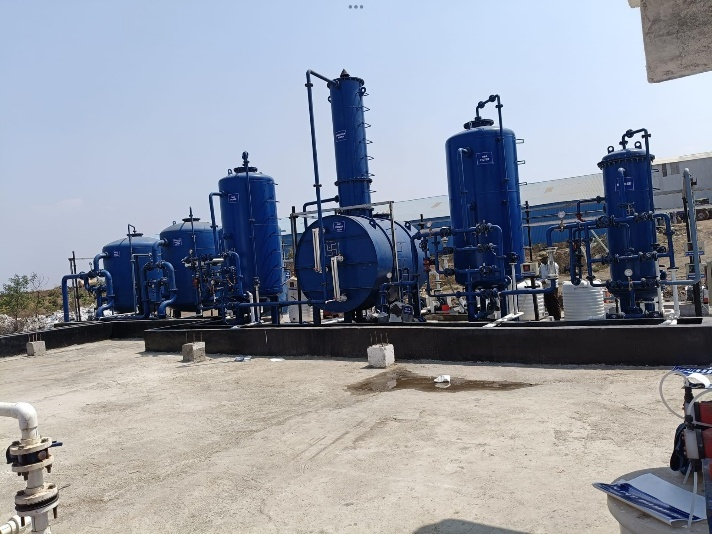
Demineralization plant
Demineralization Plant is a water treatment system designed to remove dissolved
salts (ions) from water through ion exchange technology. The process results in highly purified
water, free from minerals and conductivity, suitable for industrial and laboratory applications
where water purity is critical.
DM Plants typically consist of cation and anion exchange resin units, and in some cases, a
mixed-bed unit for polishing. They are widely used where high-purity water is required beyond
conventional filtration.
Degasser
Degassifier unit is a part of a DM Plant In which, we offer a full range of degassers to suit
the packaged /custom-made Demineralization Plants [DM Plants]. Degassers when installed
downstream of the cation unit removes the carbon dioxide, thereby reducing the load on the Anion
unit. This results in cost savings by way of reduced chemical consumption. Standard units
comprise of a tower in mild steel rubber lined / FRP construction along with a blower and
transfer pump in stainless steel construction. Additional pump and blowers are offered as
options.
Mixed bed de-mineralization
Mixed bed de-mineralizer is used on the downstream of the DM unit to achieve high purity levels
in the treated water. We confer packaged and custom-built mixed bed de-mineralisers. These mixed
bed units comprise of a single vessel with a mixture of cation and anion resins and are offered
with complete service and regeneration piping, self supportive skid foundation and chemical
tanks for regeneration.
Frequently Asked Questions
A DM plant removes dissolved salts and minerals such as calcium, magnesium,
sodium, chloride, sulfate,
nitrate, and silica using cation and anion exchange resins.
The main components of a DM plant include a cation exchange unit, anion exchange
unit, mixed bed unit (optional),
regeneration system, and control valves or automation for operation.
Ion exchange replaces unwanted dissolved ions in water with hydrogen (H⁺) and
hydroxide (OH⁻) ions.
Cation resin exchanges positive ions like calcium or magnesium, while anion
resin exchanges negative ions like chloride or sulfate.
DM resins typically require regeneration after treating a specific volume of
water, depending on feed water quality and system design.
Regeneration is usually done with acid (for cation resins) and caustic soda (for
anion resins).
A two-bed DM plant has separate cation and anion exchange units, while a
mixed-bed DM plant combines both resins
in a single unit. Mixed-bed systems produce higher purity water and are often
used for polishing after two-bed treatment.
Water from a well-maintained DM plant typically has a conductivity of less than
1 µS/cm (microsiemens per centimeter),
and mixed-bed systems can achieve values as low as 0.1 µS/cm.
DM plants require regular regeneration with hazardous chemicals (acid and
caustic), produce chemical waste,
and have high operational and maintenance costs compared to other systems like
RO for moderate purity requirements.
Yes, RO systems are often used as a pre-treatment for DM plants. This reduces
the ionic load on ion exchange resins,
lowers regeneration frequency, and improves overall efficiency and
cost-effectiveness.