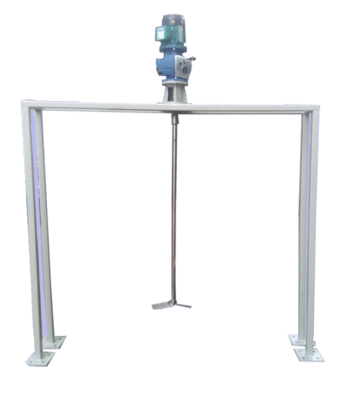
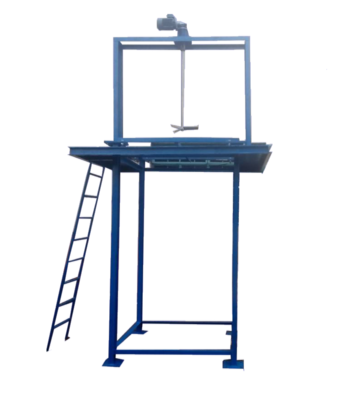
We offer a wide range of Mixing Agitators with direct drive and gear-reduced designs for both open and closed tank applications. Our agitator systems are engineered for optimal mixing efficiency, ensuring high performance, durability, and energy efficiency. Designed to meet the demands of various industries, our agitators provide precise mixing, blending, and suspension for a wide range of fluids and materials.
 Custom agitator design for
standard/custom
tanks & applications High-quality motors & gearboxes
for speed
control Available in MSEP, MS-FRP
materials as per
customer requirements Guaranteed performance for the
stated
application Compact, easy-to-install, and
maintain Solution for a wide range of
mixing
demands Superior quality with smooth,
silent, and
economical operation Properly balanced shaft
subjected to
balancing test Water & Wastewater Treatment
Chemical Industry Paper & Pulp Industry Food & Beverage Processing Pharmaceutical & Biotechnology
Power Plants & Energy Sector
Oil & Gas Industry Agriculture Petrochemical Industry
Custom agitator design for
standard/custom
tanks & applications High-quality motors & gearboxes
for speed
control Available in MSEP, MS-FRP
materials as per
customer requirements Guaranteed performance for the
stated
application Compact, easy-to-install, and
maintain Solution for a wide range of
mixing
demands Superior quality with smooth,
silent, and
economical operation Properly balanced shaft
subjected to
balancing test Water & Wastewater Treatment
Chemical Industry Paper & Pulp Industry Food & Beverage Processing Pharmaceutical & Biotechnology
Power Plants & Energy Sector
Oil & Gas Industry Agriculture Petrochemical Industry